

Everything you need yo know about limewash
Natural, mineral-based and used for centuries, limewash has become a must-have finish today, both for historic buildings and contemporary interiors. But what exactly is limewash ? What are its advantages and limitations? Which surfaces can it be applied to ? From preparation and application to choosing colours and understanding costs, discover everything you need to know before getting started.
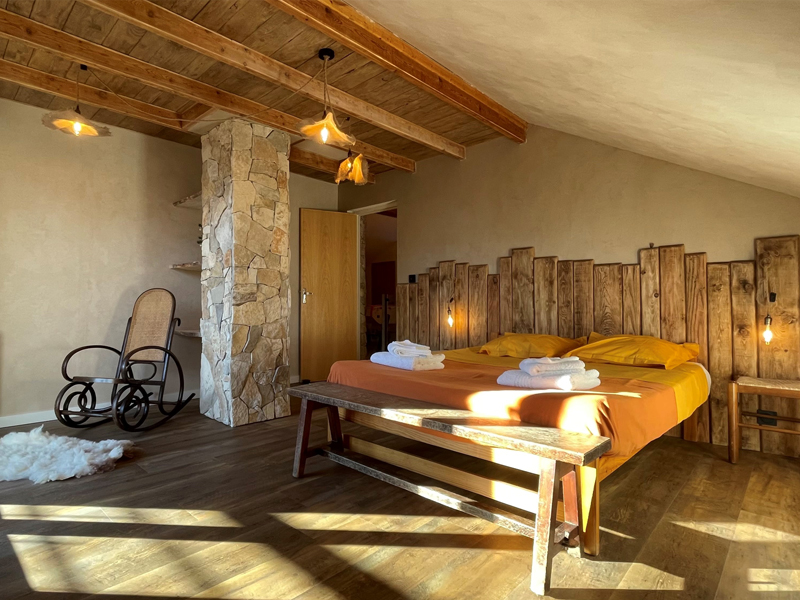
Badisof Silex & Badisof Plus lissé Silex (headboard) (realization & photo Haifa Baccouche / Atelier Bonnevie)
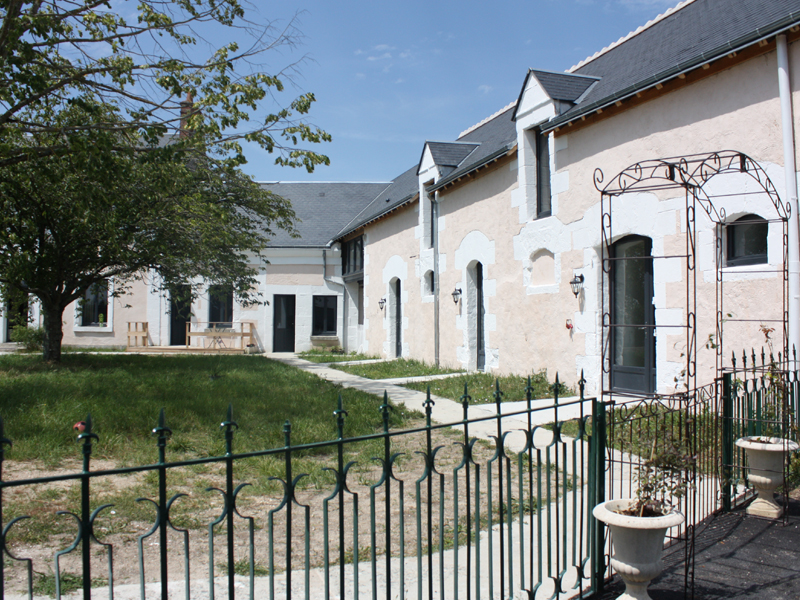
Badisof Plus Champagne & Badisof Plus naturel (wall frames) (realization & photo Les Chambres d'Emma)
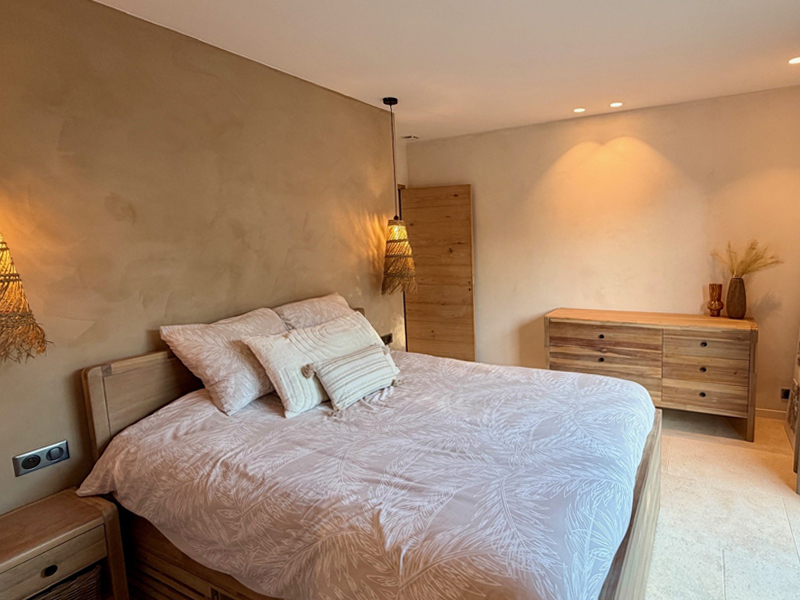
Badisof Taupe & Badisof Coton (réalisation & photo AR Maçonnerie)
1- What is limewash ?
Limewash is a natural formulation that has been used for centuries to decorate and protect the interior and exterior walls of homes. It is mainly composed of air lime, water and, when colour is desired, pigments. Unlike conventional paint, limewash creates a distinctive mineral finish that brings charm and authenticity to walls. Its appearance is generally matt, deep and more or less nuanced, with variations that are an integral part of its aesthetic. Depending on its formulation, dilution and application technique, limewash can be more or less opaque and can produce a relatively uniform finish or, on the contrary, a deliberately nuanced one.
2- What are the advantages of limewash ?
Limewash is appreciated both for its unique appearance and for the properties of lime. Permeable to water vapour, it allows the surface to breathe and promotes moisture exchange. This is one of the reasons why it has historically been used on older buildings. Lime also naturally has a high pH, which helps limit the development of certain micro-organisms. Beyond its natural qualities and the remarkable properties of lime, limewash offers a unique decorative finish. Light interacts differently with a mineral finish than with conventional paint, creating a deep, lively and authentic appearance.
3- What colours can you achieve with limewash ?
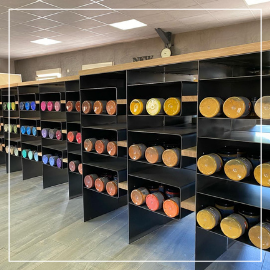
Lime is naturally white. To obtain other shades, pigments can be incorporated into the limewash. We offer our ready-to-use Badisof and Badisof Plus products in 88 and 55 shades respectively, but if you wish to colour them yourself and/or make your own limewash formulation from A to Z, you can choose from our 83 pigments to create your own colour. However, it is important to bear in mind that the whiteness of the lime will considerably lighten the colour of the pigment powder. A pigment that appears very intense in powder form will therefore produce a much softer shade once mixed with lime, often lightened by as much as half. A red, for example, may turn pink when mixed with lime. Achieving extremely dark colours is therefore quite difficult, and simply adding more pigment is not the solution. Once saturation has been reached, adding more pigment will not intensify the colour, but the limewash may release excess pigment. It is, however, possible to obtain a more vivid shade after applying limewash by using the fresco technique with limewater.
Example with ocre rouge RFLES :
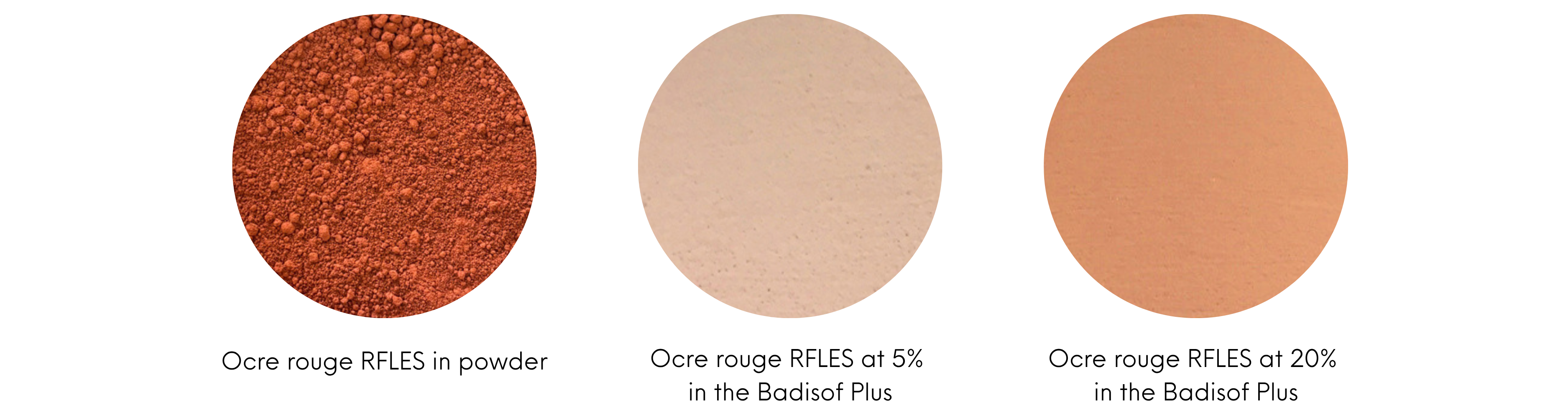
Also keep in mind that the application technique will have a considerable impact on the colour: for example, a brushed or smoothed Badisof Plus will not have the same colour at all, even with exactly the same composition and pigment dosage. The thickness of the coat, the technique used and your application method will all affect the shade. In addition, lime is a living material: your limewash will be unique depending on the light in your room, the time of day, your flooring and your furniture.
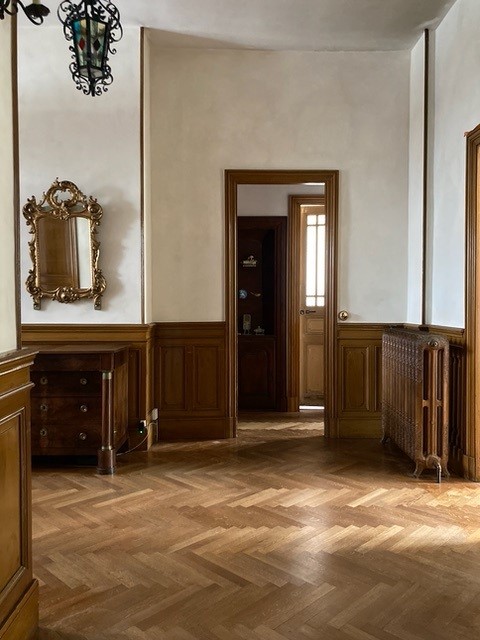
Badisof Sienna (realization & photo Sharon)
4- Which pigment should you use and how should they be dosed in limewash ?
Ochres and earth are particularly well suited to limewash and can be used to obtain yellow, beige, orange, pink, red and brown shades, as well as greens with certain earth pigments. Synthetic pigments, on the other hand, considerably broaden this palette with colours that cannot be obtained naturally, such as blues, and make it possible to achieve stronger, more intense and vivid colours. Although synthetic pigments make it possible to obtain a wider range of shades, we recommend using natural pigments for exterior applications, as they offer much better UV resistance. The recommended dosage is a maximum of 20% for a natural pigment and 15% for a synthetic pigment in a properly modified limewash (stay closer to 15% for a natural pigment and 5–7% for a synthetic pigment if your limewash is made solely from lime). Don't panic when applying your limewash : the colour will be significantly darker when wet, but will lighten by half as it dries.
5- Can limewash be applied to any surface ?
Limewash can be applied directly to a surface that has previously been prepared with lime (limewash, render). On other surfaces (plasterboard, plaster, existing paint, etc.), a special lime primer will need to be applied before the limewash. As limewash forms a thin coating, it will follow the surface onto which it is applied. It will therefore not fill any holes or smooth out irregularities. If necessary, the wall will need to be levelled beforehand. You should also be careful with repaired areas: differences in porosity can create visible ghosting, despite the application of a primer, which is only intended to provide an adhesion bridge and does not regulate absorption. Where repairs have been made, there are two solutions: re-render the wall beforehand or apply an acrylic paint before the primer and limewash in order to make the surface uniform again.
6- Is limewash suitable for all types of rooms and/or exterior use ?
Limewash is suitable for all rooms, provided they are properly ventilated. In a bathroom, however, it is not intended for areas exposed directly to water, such as a shower. For this type of application, choose Tadelakt, for which we recommend taking a training course before getting started. For brushed limewash, which does not have a sealed finish, avoid areas frequently exposed to oil splashes (for example : it is suitable for a kitchen, but a splashback should be used in the most exposed areas).
Limewash can be applied outdoors depending on its composition. For example, our Badisof Plus is perfectly suitable, but bear in mind that it is not a render. It is intended solely to refresh the colour of a façade and not to renovate it (filling holes, smoothing out irregularities, repairing cracks, etc.).
.jpeg)
Badisof Plus Craie lissé (kitchen and ceilling) + Badisof Grain de sable (back wall) (realization & photo Haifa Bonnevie)
7- Comment appliquer un badigeon de chaux ?
Limewash can be applied using different techniques. It can be brushed, smoothed, floated or applied as stucco… You can watch our application videos for the brushed technique (https://www.youtube.com/watch?v=DMxfe9LpVlQ) and the smoothed technique (https://www.youtube.com/watch?v=AVhR-L960ao).
Brushed limewash is applied with a brush (choose yours HERE), in two cross-brushed coats. The first coat will be more diluted than the second. The brushed finish will be more or less textured and grainy depending on its composition. Depending on the application technique, the finish can be relatively uniform or, on the contrary, highly nuanced. The movement, the pressure, the way each cross-brushed stroke overlaps : the application technique determines the final appearance. Dilution is equally important : the thicker the limewash, the more visible the brush marks will be.
Smoothed limewash, on the other hand, is applied in one thicker coat (around 1 mm) using a trowel, sponge and smoothing trowel. The more the limewash is burnished, the smoother and more nuanced the finish will be, and the darker the colour will appear. With certain formulations, it is even possible to achieve a true mirror finish. The finish can be as smooth as polished plaster or polished concrete.
8- How much does limewash cost ?
Contrary to popular belief, limewash is very affordable, although this obviously depends on the brand. The renewed interest in lime in recent years has led to price increases for some ready-to-use products. At Ocres de France, you can expect to pay €40 for 20 m² with a brushed finish (including 2 coats), or 4 m² with a smoothed finish, with our Badisof and Badisof Plus products. Of course, you can also make your own limewash by purchasing the ingredients separately (lime, pigment(s), admixtures, filler, etc.). The price can therefore vary considerably from one formulation to another.
9- How do you maintain limewash ?
For smoothed limewash, it is possible to apply a wax as a finishing coat. This can add a slightly satin appearance and darken the shade slightly, but above all, it will fully protect your wall. For brushed limewash, we do not recommend applying a finishing product. If you need to freshen it up, you can simply apply a new coat, dampening the surface beforehand if necessary..
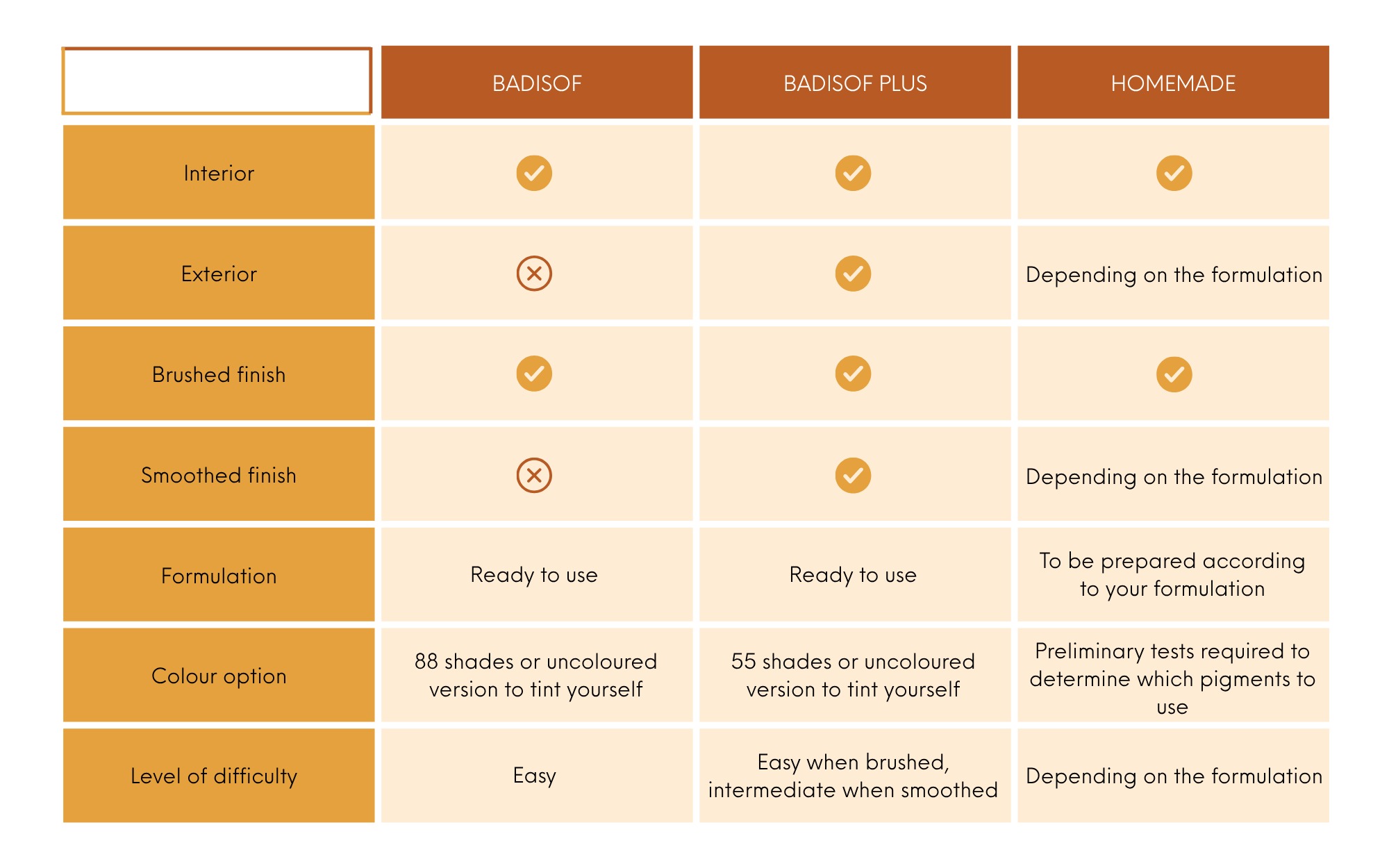
10- Which should you choose : Badisof, Badisof Plus or homemade limewash ?
It is entirely possible to make your own limewash by finding the resources needed to prepare the formulation in books and online. However, preliminary tests will be necessary, which can make the process more time-consuming. To find out more about homemade limewash, you can read our article How to make your own limewash.
In 2005, we created a range of ready-to-use limewashes : Badisof and Badisof Plus. Our products are supplied in powder form, firstly to avoid the need to add preservatives and secondly to avoid adding unnecessary weight, which inevitably increases transport costs. This also allows you to adjust the dilution as you wish to obtain a more or less liquid limewash.
Badisof is applied with a brush and is intended for interior use only. It is less grainy than Badisof Plus and has a softer, more velvety appearance. Its colours are also lighter and more pastel.
By contrast, Badisof Plus has a coarser grain, allowing it to be used both indoors and outdoors and also to be applied with a smoothed finish. Consumption will, however, be higher when applied with a smoothed finish (4 kg for 20 m² when brushed, 4 kg for 4 m² when smoothed). Our advice: combine the two finishes, with brushed Badisof walls for a softer, more subtle look and one wall finished with smoothed Badisof Plus, which will create contrast and add even more character to your room.
Our limewashes are available uncoloured (to leave as they are or tint yourself) or pre-coloured in our factory (88 shades for Badisof and 55 shades for Badisof Plus). If your surface is unsuitable (not lime-based but uniform and without repaired areas), you will need to apply a primer before your limewash. Sofadher is ideal before applying Badisof, while Sofix is the perfect primer before applying Badisof Plus. In the case of repaired or uneven surfaces, choose a render to make the surface uniform again (Rénodress, for example). If in doubt, you can contact us.
The technical data sheets for our products are available in the “Downloads” section of each product page on our website. You can also watch our application videos on YouTube : Badisof and smoothed Badisof Plus (if you wish to apply Badisof Plus with a brush, the procedure is the same as for Badisof, while following the water proportions specified for Badisof Plus).
You now have the essential knowledge about limewash and all that’s left is to get started. Haven’t found the answer to one of your questions ? Feel free to contact us at infos@ocres-de-france.com.